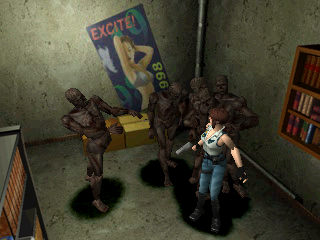
Total Time: 4 hours, 36 minutes
# of saves: 22
Ending: Bad
So that run could have went better. As for the ending, I plead ignorance; by the time I remembered how to save Barry it was too late, and in all of my dying and replaying sections of the game, I completely forgot to grab the first MO disk in order to save Chris. It may have been a blessing in disguise though – I was hanging on by a thread with no health items and very little ammo, and as it turns out the bad ending also means you don't have to do the final Tyrant fight.
So now that I can put Resident Evil: Director's Cut aside again, the question is whether or not I still feel the game holds up today. Truth is I'm probably not the best person to answer this question. Despite what my performance says I still know the game very well, so it wasn't even a reasonable facsimile of someone who were playing the game blind in 2011. On top of that, Resident Evil was my first Playstation game, and at the time I hadn't played a game with this kind of scope in terms of exploration and presentation (Super Metroid not withstanding, but alas I wasn't old enough to 'get' the subtle nuance of that game and therefore it was lost on me), so although it's not my favorite survival horror or even Resident Evil game, I still have a lot of nostalgia for it.
That said, it's no secret that people like me who enjoy the slower pace and more open ended nature of games like these are in the minority. Resident Evil is not a game that is kind to the player (or at least, not the arrange mode – apparently the only mode I've ever played increases the enemy count and also makes them tougher to destroy), in ways that can be just frustrating unless you properly pace out your saving. It was during a generation of gaming where the hobby didn't have the same demographics and sales numbers it does today, or to put it bluntly, it didn't need to be accessible in order to be competitive. I don't prescribe to the theory that accessible gaming automatically means dumbed down – Resident Evil 4 is a very smart game in it's own right. It's just different. I've accepted that Resident Evil is very different now than it was in 1995 – and I've got other games to play that aren't looking to appeal to everyone, just older gamers like me. And there's nothing wrong with either style.
Ok, enough of Resident Evil, let's talk Silent Hill.
Silent Hill
Day 1
Alchemilla Hospital
So I'm cheating a bit with this one. I'm starting from a save at Midwhich Elementary that I've had on my Playstation 3 from when I first bought the game off of PSN. It's not that far into the game and arguably when it starts to get fun. Apparently I remember this game a lot better than I do Resident Evil, which is funny being that I've played the latter about a dozen more times than I ever played Silent Hill 1.

Truth be told, I never owned a copy of Silent Hill when it was new. I read a magazine strategy guide around the time the game came out. It sounded different, so I rented and beat the game during the rental period. At the time I thought it was pretty good and didn't think about it ever again until the sequel was released years later, at which point I became obsessed with the series like the rest of the internet. Since then I've played SH1 maybe two or three more times. All told, I don't have the same experience with this game the way I do others in the genre.
Like before, I'll do a full post later in the week, but here are some quick observations -
- The game forgoes the majority of Resident Evil's resource management. There's no limited inventory, you can save as much as you want (in save rooms anyway) and health and ammo are handed out like candy.
- Amazingly, the above doesn't do anything to kill the tension. Silent Hill isn't afraid to pack a hallway full of enemies, all of which can kill you very quickly if your finger isn't mashing the inventory button. You wouldn't think Silent Hill would be more of an action game, but there you go!
- The jammed doors are still annoying, but it's nice that they serve the function of being rooms you can enter in the dark world to give the two versions of the dungeons some degrees of separation. It makes their inclusion in later Silent Hill games seem unnecessary.